Pantheism: Books
Further resources, if available, can be found in our full bibliography.

Pantheism and Ecology: Cosmological, Philosophical, and Theological Perspectives
Luca Valera
Springer
2023
This book provides a comprehensive overview of the relationship between pantheism and ecology, particularly considering different cultural approaches and diverse religious, theological, and philosophical traditions. In addition to pantheism, many chapters in this volume focus on panentheism as well. This book is oriented to a wide public, interested in environmental issues and looking for an approach from different cultures and traditions. Evidently, due to its “academic” nature, this book is also intended to be a great support for researchers interested in eco-theology and, more specifically, in the relationship between pantheism and ecology.

This volume from the Cambridge Elements: Philosophy of Religion Series focuses on some core conceptual and ontological issues related to pantheistic conceptions of God by engaging with recent work in analytic philosophy of religion on this topic. The conceptual and ontological commitments of pantheism are contrasted with those of other conceptions of God. The concept of God assumed by pantheism is clarified and the question about what type of unity the universe must exhibit in order to be identical with God receives the most attention. It is argued that the sort of unity the universe must display is the sort of unity characteristic of conscious cognitive systems. Some alternative ontological frameworks for grounding such cognitive unity are considered. Further, the question of whether God can be understood as personal on pantheism is explored.

In this book, Mary-Jane Rubenstein investigates this perennial repugnance through a conceptual genealogy of pantheisms. What makes pantheism “monstrous”–at once repellent and seductive–is that it scrambles the raced and gendered distinctions that Western philosophy and theology insist on drawing between activity and passivity, spirit and matter, animacy and inanimacy, and creator and created. By rejecting the fundamental difference between God and world, pantheism threatens all the other oppositions that stem from it: light versus darkness, male versus female, and humans versus every other organism. If the panic over pantheism has to do with a fear of crossed boundaries and demolished hierarchies, then the question becomes what a present-day pantheism might disrupt and what it might reconfigure. Cobbling together heterogeneous sources–medieval heresies, their pre- and anti-Socratic forebears, general relativity, quantum mechanics, nonlinear biologies, multiverse and Indigenous cosmologies, ecofeminism, animal and vegetal studies, and new and old materialisms–Rubenstein assembles possible pluralist pantheisms. By mobilizing this monstrous mixture of unintentional God-worlds, Pantheologies gives an old heresy the chance to renew a person’s thinking.
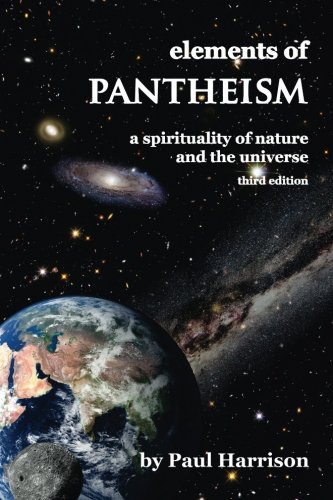
Elements of Pantheism: A Spirituality of Nature and the Universe
Paul Harrison
CreateSpace Independent Publishing Platform
2013
The writing of this book gave rise to the World Pantheist Movement. As Paul Harrison researched and wrote it, he developed an online community which grew into the WPM in 1998. Elements of Pantheism, the only summary of pantheist history, theory and practice in print at the time, was first published in 1999 by Element Books as part of a series on world religions. It was conceived as a book that would provide a comprehensive overview written in a clear and readable way for the general reader.
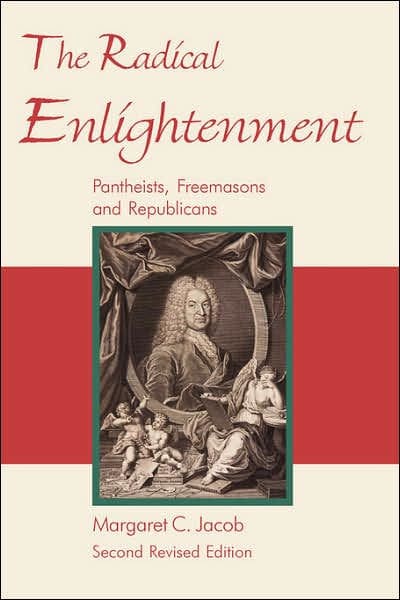
The Radical Enlightenment: Pantheists, Freemasons and Republicans
Margaret C. Jacob
Cornerstone Book [George Allen and Unwin, 1981]
2006 (Second edition)
When first published in 1981, The Radical Enlightenment encountered both praise and blame. In the course of time it became a classic. In the era after 1985 the book was perhaps the first English language scholarly work to address freemasonry seriously. The new edition attempts to modernize the footnotes, removes a few errors in transcription found in quotations used in the first edition, and not least, offers a new preface. The thesis presented in The Radical Enlightenment has withstood the test of time and in the last twenty years been augmented and made more distinct by a variety of historians working on both sides of the Atlantic.
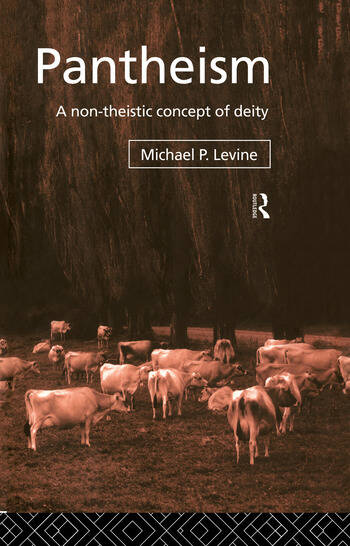
Many people who do not believe in God believe that “everything is God”–that everything is part of an all-inclusive divine unity. In Pantheism, this concept is presented as a legitimate position and its philosophical basis is examined. Michael Levine compares it to theism, and discusses the scope for resolving the problems inherent in theism through pantheism. He also considers the implications of pantheism in terms of practice. This book will appeal to those who study philosophy or theology. It will also be of interest to anyone who does not believe in a personal God, but does have faith in a higher unifying force, and is interested in the justification of this as a legitimate system of thought.
Photo Credit: Jay Mantri/Unsplash